
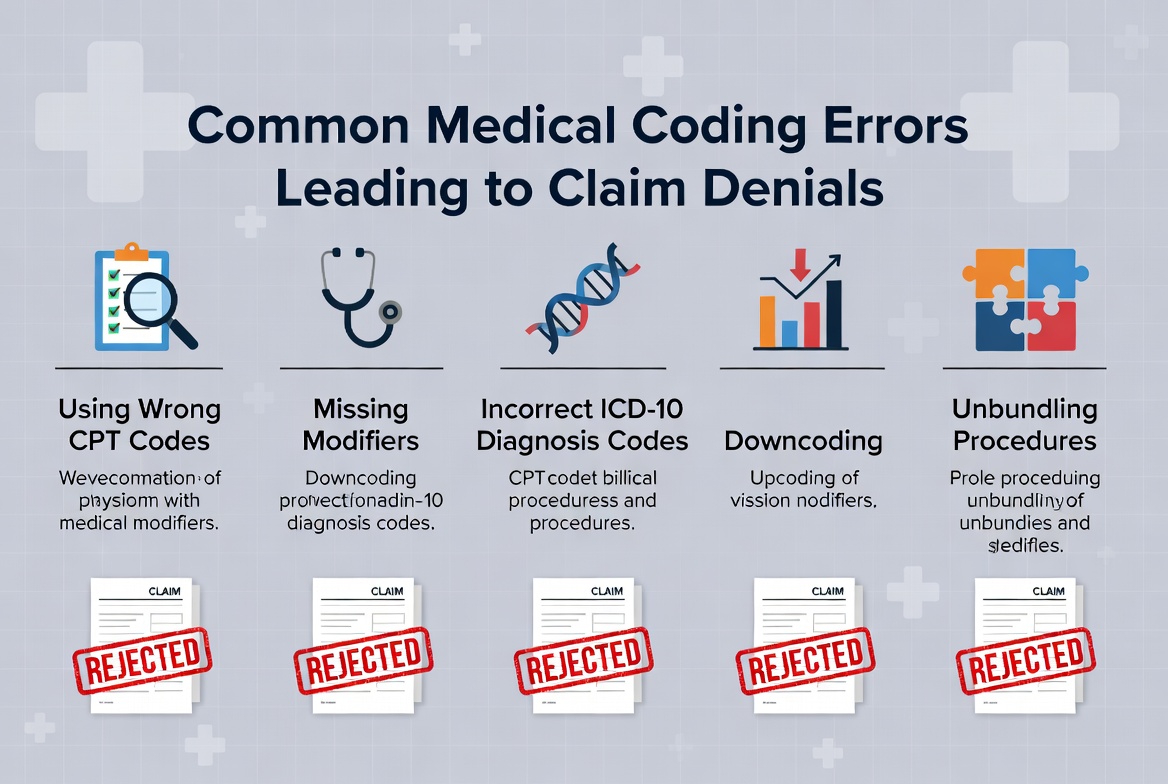
Medical coding errors cost healthcare providers billions of dollars annually in denied claims and delayed reimbursements. According to industry research, nearly 80% of medical bills contain errors, with coding mistakes being a leading cause of insurance claim rejections. Understanding these errors and implementing preventive strategies can significantly improve your revenue cycle management.
What Are Medical Coding Errors in Healthcare?
Medical coding errors occur when healthcare providers incorrectly translate patient diagnoses, procedures, and services into standardized alphanumeric codes. These codes—including ICD-10, CPT, and HCPCS—form the foundation of insurance claims and reimbursement processes.
When coders make mistakes, insurance companies reject or deny claims, creating financial losses and administrative burdens for healthcare organizations. More importantly, these errors can delay patient care and damage provider-payer relationships.
The Top 7 Medical Coding Errors That Trigger Claim Rejections
1. Upcoding and Undercoding
Upcoding happens when providers bill for more expensive services than what was actually performed. Conversely, undercoding occurs when less expensive codes are used, resulting in lower reimbursement.
Common examples:
- Billing for a comprehensive office visit when only a basic consultation occurred
- Using a simple procedure code for a complex surgical intervention
How to prevent it: Implement regular coding audits and ensure documentation accurately reflects the services provided. Train your coding team on proper code selection based on medical necessity.
2. Incorrect or Missing Patient Information
Simple demographic errors cause thousands of claim rejections daily. These include misspelled names, incorrect date of birth, wrong insurance ID numbers, or outdated policy information.
Step-by-step prevention guide:
- Verify patient information at every visit
- Cross-check insurance card details against your records
- Implement electronic verification systems
- Update patient demographics before claim submission
- Train front-desk staff on data accuracy importance
3. Mismatched or Unspecified Diagnosis Codes
Using outdated ICD-9 codes instead of ICD-10, selecting non-specific codes when specific ones are available, or mismatching diagnosis codes with procedures creates immediate red flags for insurance companies.
Real-world scenario: Billing for knee surgery with a diagnosis code for shoulder pain will result in automatic rejection due to medical necessity questions.
Prevention strategy: Always ensure diagnosis codes support the medical necessity of procedures performed. Use the most specific code available in the ICD-10 system.
4. Duplicate Billing
Duplicate billing occurs when the same service is billed multiple times for the same patient encounter. This often happens due to system errors, miscommunication between departments, or resubmission mistakes.
How to identify duplicates:
- Review claim submission reports weekly
- Implement automated duplicate detection software
- Establish clear communication protocols between billing staff
- Create a tracking system for resubmitted claims
5. Unbundling of Services
Unbundling involves billing separately for services that should be billed together as a single comprehensive code. Insurance companies have strict bundling rules, and violations trigger immediate denials.
Example: Billing separately for anesthesia, the surgical procedure, and post-operative care when a single comprehensive code exists for the entire service package.
Solution: Utilize coding software with built-in bundling edits and regularly update your team on payer-specific bundling requirements.
6. Missing or Inadequate Documentation
Even correct codes will be rejected if supporting documentation is insufficient. Insurance companies require detailed medical records that justify the medical necessity of services billed.
Documentation best practices:
Level 1 – Basic requirements:
- Patient symptoms and complaints
- Physical examination findings
- Treatment plan
Level 2 – Complete documentation:
- Detailed history of present illness
- Review of systems
- Medical decision-making process
- Time spent (for time-based billing)
Level 3 – Supporting evidence:
- Lab results and imaging reports
- Specialist consultation notes
- Progress notes for ongoing treatment
7. Coding for Services Not Covered by Insurance
Submitting claims for non-covered services or procedures that require pre-authorization without obtaining approval leads to guaranteed rejections.
Prevention checklist:
- Verify coverage before scheduling procedures
- Obtain pre-authorization for required services
- Inform patients of potential out-of-pocket costs
- Keep updated lists of payer-specific coverage policies
- Document medical necessity thoroughly
The Financial Impact of Coding Errors on Your Practice
Medical coding errors don’t just cause claim rejections—they create cascading financial problems:
- Delayed cash flow: Each rejected claim adds 15-30 days to your payment cycle
- Administrative costs: Staff time spent on appeals and resubmissions
- Write-offs: Claims denied beyond filing deadlines become uncollectible
- Compliance risks: Repeated errors can trigger audits and penalties
- Patient dissatisfaction: Billing errors create trust issues and payment disputes
How to Reduce Medical Coding Errors: A Step-by-Step Action Plan
Step 1: Invest in Ongoing Education
Medical coding updates occur regularly. Ensure your coding team receives continuous training on:
- Annual ICD-10 and CPT updates
- Payer-specific coding guidelines
- Documentation requirements
- Compliance regulations
Step 2: Implement Technology Solutions
Modern coding software reduces human error through:
- Real-time coding validation
- Automated duplicate detection
- Bundling and unbundling alerts
- Integration with electronic health records (EHR)
Step 3: Establish a Quality Assurance Program
Create a systematic review process:
- Conduct random coding audits monthly
- Review all denied claims for error patterns
- Provide targeted feedback to coders
- Track error rates and improvement metrics
Step 4: Improve Provider-Coder Communication
Many coding errors stem from unclear or incomplete provider documentation. Bridge this gap by:
- Holding regular meetings between clinical and coding staff
- Creating documentation templates for common procedures
- Implementing query systems for unclear documentation
- Providing real-time coding support during complex cases
Transform Your Revenue Cycle with Professional Coding Solutions
Medical coding errors are preventable, but they require systematic approaches, ongoing education, and the right technology infrastructure. Don’t let coding mistakes drain your practice’s revenue and resources.